Grouting Gains Ground for HDD Railroad Crossings
Published: 10/08/2026
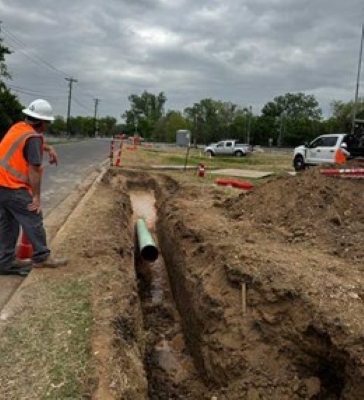
(UI) - While not universally used for every horizontal directional drilling project, annular space grouting may be turning into the industry standard for projects that drill beneath critical infrastructure, such as railroad tracks.
“We did know that some railroads were starting to require grout underneath their right-of-way,” said Jim Watland of Watland Custom Underground LLC.
In March, his company completed a 450-foot drilling and grouting project underneath a set of two parallel railroad tracks in Bellmead, Texas. “We did not know for sure if they were going to require it until we got on the job site,” he said.
A creek running alongside the tracks had washed out, and an existing gas line that needed to be replaced was being moved, he said. Originally, the project was supposed to be a 300-foot bore, and it is typical for conduits to extend at least another 50 feet on each side of a railroad track. In this case, the right-of-way was wider than usual.
“We had to extend our bore 100 feet to get outside of the right-of-way where we could dig; they would not let us dig and do what we needed to do with the pipe in their right-of-way,” Watland said. “So that’s what extended the bore to 450 feet.”
Grout
Drilling about 18 feet beneath the tracks, Watland’s crew installed a 10-inch steel casing – and because the reamer used was more than one inch bigger than the pipe, the railroad company required the annular space be filled with grout.
“They said if I kept my reamer only one inch bigger than the pipe, then I would not have to pump grout. But because I went larger – and they still would only let me go up to 14 inches – they wanted me to fill that in with grout so that, over time, the ground would not settle and the railroad tracks would not sink in,” Watland said.
Years ago, grout would have just been used to cap the ends of the bore, he said.
“This year is the first time we have had companies – TxDOT, railroad, whatever – enforcing us to pump grout through the whole bore, filling the void underneath their right-of-way,” Watland said.
For guidance with the grout, he turned to Don White, owner of DCS Fluid Solutions. White recommended Baroid Industrial Drilling Products Bore-Grout, a bentonite-based horizontal heat loop grout. He also provided a project estimate calculating that one sack of grout should be used for every 20 gallons of fluid. Also, with 510 gallons of annular space, Watland would need at least 26 sacks, and should pump 51 gallons of grout per every 10 feet of pipe joint pulled into the bore.
Watland ordered a pallet of 48 and mixed up the required 26. Because the bore ended up being longer in length than originally thought, he did end up using extra bags.
White also instructed him not to stop circulating the grout mix pits.
“There is one thing specific to this type of grout – it won’t set up until it’s stagnant,” White said. “So as long as the product is moving, kept stirring, you don’t have any danger of it locking up in your pits. But when it gets down the hole, then it begins to set up because there’s no longer any shear taking place.”
Limited time
That gave Watland about two hours and ensured he did more advance due diligence to ensure that none of that two hours would be lost to preventable incidents such as equipment repairs.
“With this grout in there, you can’t stop, so you want to make sure everything’s in tip-top shape and ready to go,” he said. “I was not going to take any chances.”
It is advantageous that, because this grout is not cement-based, specialized equipment is not needed for it, White pointed out.
“I think it’s a good thing they have come up with this as that allows us to do projects we might not have been able to do otherwise,” he said. “We want something that the drilling contractor can do by himself without having to hire extra equipment and expense.”
Typically, Watland never would have put grout underneath a borehole. In his opinion, it’s extraneous.
“To me, there’s no need for it,” Watland said. “There’s been studies done where they actually went back six months, a year, two years later, and dug up boreholes, and the fluid – the ground that we mix up and then the bentonite that we use – pretty much sets up as hard or harder than the ground was before we drilled through it.”
However, “it’s starting to become industry standard,” he said.
“Since then, we have had to do another project in Marble Falls, where we were boring underneath the TxDOT highways, and they had me do the grout while we were pulling the pipe,” Watland said. “The experience that we learned from the railroad tracks, we were able to use that on the next project, and now I actually have one or two more railroad tracks that I’m assuming I’m going to have to do grout with.”
With the completion of the Bellmead project, having first drilled into rock and then filled in the void with grout, those railroad tracks are well-protected.
“There should never, ever be a problem,” he said.
FOR MORE INFORMATION:
Watland Custom Underground, (940) 391-5339, watlandcustomundergroundllc.com
DCS Fluid Solutions, (940) 768 8071, dcsmud.com
Originally published as “Grouting Gains Ground for HDD Railroad Crossings” by Corinna Hunt, Contributing Editor, in Underground Construction, September 2026, Vol. 81, No. 9.